

- UKRAINE

President Vladimir V. Putin of Russia launched an invasion of Ukraine on Feb. 24, 2022 just as diplomats at the United Nations Security Council were calling on him to refrain from war and hours after Ukraine’s president made an impassioned bid for peace, appealing to the Russian people to remember their ties to his country.
It is not just Ukraine’s 44 million people whose lives have been upended. In the coming days, many others far from the field of battle maybe find themselves buffeted by ripple effects. The fate of Ukraine has enormous implications for the rest of the continent, the health of the global economy, and even America’s place in the world.
Moscow’s move against Ukraine, once a member of the Soviet Union, is sure to increase fears over the security of other former Soviet countries in Eastern Europe. It will heighten concerns about the strength of the post-1989 international order and America’s ability to influence it. It could also raise fuel prices across the world.
BECAUSE OF PUTIN’S DESIRE TO REBUILD THE SOVIET UNION, HE AUTHORIZED A MILITARY INVASION OF THE COUNTRY. HE COMMITTED WAR CRIMES, TORTURE, AND THE DESTRUCTION OF INNOCENT PEOPLE!
Why is Ukraine so vulnerable?
Though given money and arms by the West, Ukraine is not actually a NATO member, and so cannot count on the direct military support of the United States and its allies. And for all the hundreds of millions of dollars in Western aid its military has been given in recent years, it is still no match for Russia’s.
Ukraine is also surrounded by Russian allies and proxies — and by Russia itself.
During the lead-up to the invasion, Russian troops massed not only along Ukraine’s eastern border with Russia, but also along the Belarusian border, a little more than 50 miles north of Kyiv, the Ukrainian capital. Russian troops were also stationed in Transnistria, a small and unrecognized breakaway region from Moldova, to Ukraine’s west. That set the stage for an invasion from multiple directions.
What could the economic effects of the invasion be?
Some of the world’s main grain supplies are routed through the Black Sea, which borders both Russia and Ukraine, two major wheat producers. Military action could disrupt both grain production and distribution, raising food costs for consumers across the world.
Russia supplies about a third of Europe’s gas, much of which is currently shipped through Ukraine. Any disruption at either end of that supply chain would force European countries to look elsewhere for fuel, most likely raising world oil prices.
Before the invasion, President Biden stepped up sanctions against Russia, blocking two of its large financial institutions from Western finance and limiting Russia’s access to debt markets. He said the new measure was aimed at a subsidiary of Gazprom, the Russian energy giant, which built the Nord Stream 2 gas pipeline. The European Union also took aim at President Putin’s inner circle with an array of sanctions.
What did Russia take from Ukraine?
Why do Russia, the U.S., and Europe care so much about Ukraine?
Both Russia and the West see Ukraine as a potential buffer against each other.
Russia considers Ukraine within its natural sphere of influence. Most of it was for centuries part of the Russian Empire, many Ukrainians are native Russian speakers and the country was part of the Soviet Union until winning independence in 1991.
Russia was unnerved when an uprising in 2014 replaced Ukraine’s Russia-friendly president with an unequivocally Western-facing government.
Most former Soviet republics and allies in Europe had already joined the European Union or NATO. Ukraine’s lurch away from Russian influence felt like the final death knell for Russian power in Eastern Europe.
To Europe and the United States, Ukraine matters in part because they see it as a bellwether for their own influence, and for Russian intentions in the rest of Europe.
Ukraine is not part of the European Union or NATO. But it receives considerable financial and military support from Europe and the United States. Russia’s invasion suggests that Moscow might feel empowered to turn up the pressure on other former Soviet republics that are now members of the Western alliance, like Estonia, Latvia, and Lithuania.
War Crimes
An array of international criminal laws emerged after World War II, most famously the Geneva Convention of 1949, which aims to hold combatants personally responsible for war crimes — such as intentionally slaughtering civilians, torture, wanton destruction of property, sexual violence, pillaging, conscripting children. Other measures included the Genocide Convention and laws prohibiting crimes against humanity.

The apocalyptic images of bodies sprawled in the mud among twisted tanks, charred walls, and splintered trees in Bucha and other Ukrainian cities speak to the brutality of the war that Vladimir Putin started. The knowledge that more such horrors, many more, will be revealed as Russian troops retreat cries out for a reckoning.
Russia, for the record, says the atrocities in Bucha are all staged. And it may well be that investigators will find evidence of atrocities committed by Ukrainian troops against Russians or collaborators. All the more reason to conduct a thorough accounting.
Delivering justice — collecting the evidence, securing an indictment, holding a fair trial — is hard, time-consuming, and expensive. As such, few instances of war crimes lead to punishment. Though the I.C.C. can initiate prosecution on any act of genocide, crime against humanity, or war crime on its own, a charge of the crime of aggression — the one most applicable to Mr. Putin and his lieutenants — would have to be initiated by the United Nations Security Council, where it would face a certain Russian veto. In addition, Russia does not recognize the I.C.C. and would not surrender suspects.
International Criminal Court (I.C.C)
The International Criminal Court (ICC) investigates and, where warranted, tries individuals charged with the gravest crimes of concern to the international community: genocide, war crimes, crimes against humanity, and the crime of aggression. It was established on July 1, 2002, in Rome, Italy.
The Court is participating in a global fight to end impunity, and through international criminal justice, the Court aims to hold those responsible accountable for their crimes and to help prevent these crimes from happening again.
The Court cannot reach these goals alone, it relies on the justice system of the accused. An individual is indicted when a Pre-Trial Chamber issues either an arrest warrant or a summons after it finds that “there are reasonable grounds to believe that the person has committed a crime within the jurisdiction of the Court”.[1] An arrest warrant is issued where it appears necessary “to ensure the person’s appearance at trial, to ensure that the person does not obstruct or endanger the investigation or the court proceedings, or, where applicable, to prevent the person from continuing with the commission of that crime or a related crime which is within the jurisdiction of the Court and which arises out of the same circumstances”.[1] The Pre-Trial Chamber issues a summons if it is satisfied that a summons is sufficient to ensure the person’s appearance.[1]In summary, the police of the suspect have to lock up the suspect and perform extradition.
As a court of last resort, it seeks to complement, not replace, national Courts. Governed by an international treaty called the Rome Statute, the ICC is the world’s first permanent international criminal court.
- Bahr Abu Garda was indicted on 7 May 2009 on three counts of war crimes with regard to the situation in Darfur, Sudan.
- Mohammed Ali was indicted on 8 March 2011 on five counts of crimes against humanity with regard to the situation in the Republic of Kenya.
- Abdallah Banda was indicted on 27 August 2009 on three counts of war crimes with regard to the situation in Darfur, Sudan.
- Omar al-Bashir was indicted on 4 March 2009 on five counts of crimes against humanity and two counts of war crimes with regard to the situation in Darfur, Sudan.[
- Jean-Pierre Bemba was indicted on 23 May 2008 on two counts of crimes against humanity and four counts of war crimes with regard to the situation in the Central African Republic (CAR).
- Charles Blé Goudé was indicted on 21 December 2011 with four counts of crimes against humanity with regard to the situation in the Republic of Côte d’Ivoire.
- Muammar Gaddafi was indicted on 27 June 2011 on two counts of crimes against humanity with regard to the situation in Libya.
- Saif al-Islam Gaddafi was indicted on 27 June 2011 on two counts of crimes against humanity with regard to the situation in Libya.
- Laurent Gbagbo was indicted on 23 November 2011 on four counts of crimes against humanity with regard to the situation in the Republic of Côte d’Ivoire.
- Simone Gbagbo was indicted on 29 February 2012 on four counts of crimes against humanity with regard to the situation in the Republic of Côte d’Ivoire.
- Ahmed Haroun was indicted on 27 April 2007 on 20 counts of crimes against humanity and 22 counts of war crimes with regard to the situation in Darfur, Sudan.
- Abdel Rahim Hussein was indicted on 1 March 2012 on 13 counts of crimes against humanity and six counts of war crimes with regard to the situation in Darfur, Sudan.
- Saleh Jerbo was indicted on 27 August 2009 on three counts of war crimes with regard to the situation in Darfur, Sudan.
- Germain Katanga was indicted on 2 July 2007 on three counts of crimes against humanity and six counts of war crimes with regard to the situation in the Democratic Republic of the Congo (DRC).
- Uhuru Kenyatta is the current President of the Republic of Kenya. He was indicted on 8 March 2011 on five counts of crimes against humanity with regard to the situation in the Republic of Kenya.
- Tohami Khaled was indicted on 13 April 2013 on four counts of crimes against humanity and three counts of war crimes with regard to the situation in Libya.
- Joseph Kony was indicted on 8 July 2005 on 12 counts of crimes against humanity and 21 counts of war crimes with regard to the situation in Uganda.
- Henry Kosgey was indicted on 8 March 2011 on four counts of crimes against humanity with regard to the situation in the Republic of Kenya.
- Ali Kushayb was indicted on 27 April 2007 on 22 counts of crimes against humanity and 28 counts of war crimes with regard to the situation in Darfur, Sudan.
- Thomas Lubanga Dyilo was indicted on 10 February 2006 on three counts of war crimes with regard to the situation in the Democratic Republic of the Congo (DRC).
- Raska Lukwiya was indicted on 8 July 2005 on one count of crimes against humanity and three counts of war crimes with regard to the situation in Uganda.
- Ahmad al-Mahdi was indicted on 18 September 2015 with one count of war crimes with regard to the situation in Mali.
- Callixte Mbarushimana was indicted on 28 September 2010 on five counts of crimes against humanity and six counts of war crimes with regard to the situation in the Democratic Republic of the Congo (DRC).
- Sylvestre Mudacumura was indicted on 13 July 2012 on nine counts of war crimes with regard to the situation in the Democratic Republic of the Congo (DRC).
- Francis Muthaura was indicted on 8 March 2011 with five counts of crimes against humanity with regard to the situation in the Republic of Kenya.
- Mathieu Ngudjolo Chui was indicted on 6 July 2007 on three counts of crimes against humanity and six counts of war crimes with regard to the situation in the Democratic Republic of the Congo (DRC).
- Bosco Ntaganda was indicted on 22 August 2006 on three counts of war crimes with regard to the situation in the Democratic Republic of the Congo (DRC).
- Okot Odhiambo was indicted on 8 July 2005 on three counts of crimes against humanity and seven counts of war crimes in regard to the situation in Uganda.
- Dominic Ongwen was indicted on 8 July 2005 on three counts of crimes against humanity and four counts of war crimes in regard to the situation in Uganda.
- Vincent Otti was indicted on 8 July 2005 on 11 counts of crimes against humanity and 21 counts of war crimes in regard to the situation in Uganda.
- William Ruto is the current Deputy President of the Republic of Kenya. He was indicted on 8 March 2011 on four counts of crimes against humanity with regard to the situation in the Republic of Kenya.
- Joshua Sang was indicted on 8 March 2011 on four counts of crimes against humanity with regard to the situation in the Republic of Kenya.
- Abdullah Senussi was indicted on 27 June 2011 on two counts of crimes against humanity in regard to the situation in Libya.
- Mahmoud al-Werfalli was indicted on 15 August 2017 on one count of a war crime in regard to the situation in Libya.
Based on this list, there is a flaw in ICC rules. No “Head-of-State” is prosecuted and only suspects of Africa are indicted.
The ICC must enforce its extradition policy through its military if the suspect judicial system fails to act. Vladimir Putin must be held accountable for the war crimes committed in Ukraine and Syria. 
The Syrian Observatory for Human Rights claims that Russian airstrikes and artillery shells have killed 18,000 people, including nearly 8,000 civilians, in Syria by 1 October 2018.
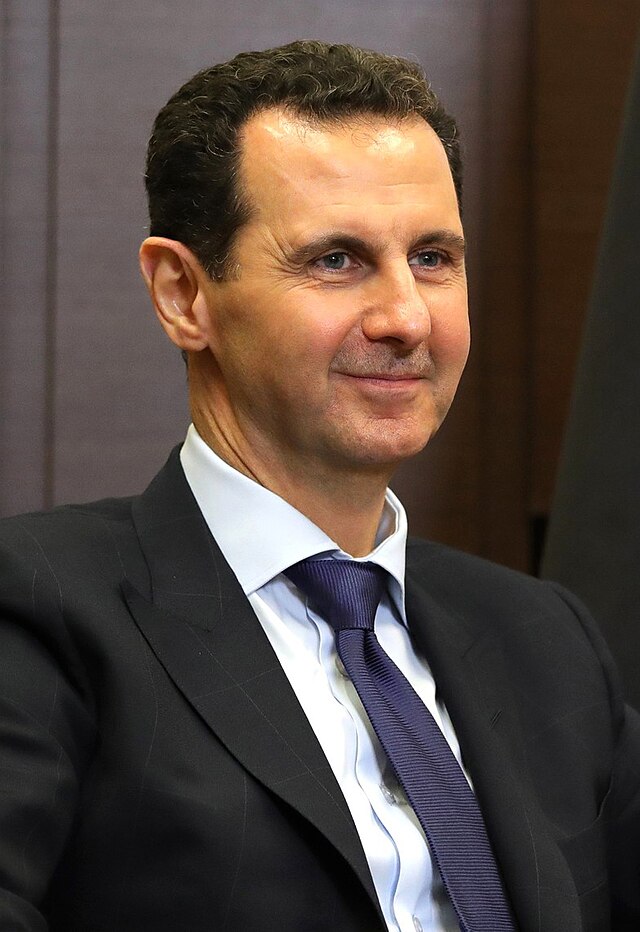 Also, Bashar Hafez al-Assad’s regime has used chemical weapons (chlorine gas) against civilians and conducted torture and extrajudicial killings. Assad has also used “Indiscriminate and disproportionate aerial bombardment and shelling” which “led to mass civilian casualties and spread terror.” Less than two weeks earlier, in the middle of the night on August 21, the Syrian military had attacked rebel-controlled areas of the Damascus suburbs with chemical weapons, killing nearly 1,500 civilians, including more than 400 children. This brazen assault had clearly crossed the “red line” that President Barack Obama had enunciated a year earlier—that if Assad used chemical weapons, it would warrant U.S. military action.
A new report by Amnesty International has documented war crimes and atrocities committed during the fall of the internationally backed Afghan government in August.
The report also recorded four airstrikes in recent years, which killed a total of 28 civilians, including 15 men, five women, and eight children. Six others were injured.
It found that three of these strikes were most likely carried out by US forces and one by the Afghan Air Force.
The strikes generally resulted in civilian deaths, because the US dropped explosive weapons in populated areas, the report said.

